
Buying Canadian a Persistent Preference and New Public Procurement Tools
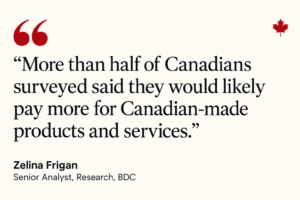
Consumer interest has deep roots. Businesses are redirecting some purchases, while governments are writing more Canadian content into their procurement rules. These shifts are moving at different speeds.
Support for buying Canadian has endured well beyond the initial response to the trade tensions of 2025. For manufacturers and retailers, the question now is how to turn that preference into regular orders. The evidence points to sustained consumer interest, changes already underway in businesses and an increasingly defined role for public procurement.
As early as 2013, an Ipsos survey for BDC of 1,023 Canadians found that 45% had made an effort in the previous year to buy products from Canada. Attention to origin therefore predates the current dispute by many years.
New efforts were still emerging in 2026. In a BDC survey of 1,500 adults conducted in February and published in April, 38% said they had tried specifically looking for Canadian alternatives to foreign goods for the first time in the preceding six months. This measures a reported search, rather than sales. It nevertheless indicates that interest was continuing to reach new consumers after the first wave of 2025.
Reported frequency provides another point of reference: in an Abacus survey conducted in June and July 2026, 53% said they made an effort to choose Canadian often or almost always. The question differs from the one asked in 2013, so subtracting the two results would not produce a valid growth rate. Together, they document a longstanding preference that remains present today.
The same Abacus survey places pride in Canada first among respondents’ stated motivations, at 30%, followed by concern for Canadian jobs and the economy, at 22%, and anger at the United States and Donald Trump, at 21%. These feelings may overlap, but buying Canadian clearly draws on several motivations.
Price still matters. When the Canadian product costs noticeably more, 19% say they buy it anyway, 43% make different choices for different products and 34% choose the cheaper option. A competitively priced offering that is easy to identify and clearly explains its value therefore has a better chance of turning interest into a purchase.
Businesses have begun redirecting purchases
In spring 2025, Statistics Canada measured actions already underway: 12.0% of business establishments with employees reported increasing domestic sourcing over the preceding three months. The share reached 26.4% in manufacturing and 33.9% among manufacturers importing from the United States. These are shares of businesses, rather than shares of dollars spent. A supplier located in Canada may also resell imported goods.
The commercial effects remain uneven. In fall 2025, the Bank of Canada reported that more firms were attributing higher sales volumes to their customers’ Buy Canadian spending, while noting that these firms still represented a small share of the total.
Public procurement adds an institutional driver
Governments can support demand over several years. The National Shipbuilding Strategy, announced in 2010, already aimed to make purchasing predictable and moderate industrial boom-and-bust cycles. Public procurement is an established tool whose reach is now evolving.
In 2024–2025, Ottawa awarded $66.9 billion in contracts, covering goods, services and construction. That total conveys the scale of its purchasing power, without representing sales exclusively of goods made in Canada. Since June 15, 2026, the policy prioritizing Canadian suppliers and content in strategic procurement has applied to contracts worth at least $5 million.
A separate rule for materials requires Canadian-produced materials in federal construction and defence goods contracts worth at least $25 million, when the requirement for a covered material, whether steel, aluminum or wood products, reaches $250,000 and Canadian supply is available, subject to the stated exceptions. This threshold applies separately to each material. The materials must be produced in Canada; the seller’s nationality alone is not enough.
Provincial governments are also taking part. The Canada–Ontario action plan announced on October 21, 2026 calls for using the Buy Canadian and Buy Ontario policies to prioritize Canadian steel in public procurement. This is an industrial policy commitment whose effects will need to be measured through awarded contracts.
Federal Crown corporations retain their own mandates and rules. They are encouraged to align with the federal framework, without all automatically falling under the same regime. These policies do not yet demonstrate a corresponding increase in sales, but they add purchasing criteria that may outlast fluctuations in public opinion.
Making the preference actionable at the point of purchase
For our network, the task is practical: make origin verifiable and visible, help buyers compare products and meet their requirements. BDC found that 50% of respondents answering the question would be encouraged by clearer information about Canadian origins. Well Made Here accreditation addresses this need for information. Sustained support is documented; turning it into regular repeat purchases will also depend on price, quality, availability and service.